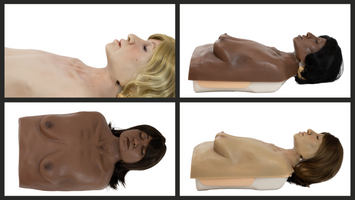
In 2020, TraumaSim launched the Manniskin—a groundbreaking, silicone overlay designed to convert the traditionally male-featured CPR manikin into a realistic female form. This launch coincided with Restart a Heart Day, a global initiative aimed at raising awareness around sudden cardiac arrest (SCA) and the importance of bystander CPR and AED use.
Our motivation was simple: people don’t save lives if they’re not prepared, and people aren’t prepared if they’re never trained to recognise or respond to cardiac arrest in a woman.
Back then, we were responding to some truly confronting statistics:
-
Over 30,000 Australians suffer cardiac arrest each year, and only 1 in 10 survive.
-
Studies from the US and Europe revealed that only 39% of women receive bystander CPR, compared to 45% of men.
-
Researchers concluded that one of the barriers was discomfort: people hesitate to touch or apply chest compressions to a woman, fearing inappropriate contact or being unsure of correct hand placement.
We asked ourselves: How can we expect someone to confidently act in a real emergency if they’ve never seen or practiced CPR on a body that looks like a woman’s?
A Bold Step Toward Realism in Training
The Manniskin was our answer.
A female-presenting, high-fidelity silicone skin—complete with breasts, realistic facial detail, lashes, hair, and pigment variation—designed to fit existing CPR manikins like Little Anne. Within seconds, a traditionally gender-neutral training session could now reflect the very real diversity of people who collapse in our streets, homes, and workplaces.
Our goal wasn’t shock—it was representation, empathy, and preparedness. Because cardiac arrest doesn’t discriminate by gender, but it seems bystander action still does.
How Has It Been Received?
Now, years later, we reflect: has anything changed?
The answer is complex.
Some trainers have embraced the Manniskin with genuine passion. They tell us how students take the training more seriously. They talk about breakthroughs in classroom conversations—questions about bias, about assumptions, and about real-world scenarios. They say it’s helped them train with empathy, challenge discomfort, and prepare students better for saving lives.
But there’s also been pushback. And it’s worth examining.
We’ve heard that:
-
“It’s too realistic.”
-
“The breasts don’t fall naturally to the side.”
-
“It’s too confronting to use in public courses.”
-
“Young male students will laugh or make jokes.”
-
“Gender doesn’t need to be shown in CPR training.”
-
“The silicone collects dust.”
-
“My students don’t like the face—it’s too lifelike.”
These aren’t just technical critiques. Many of these reactions reveal deep discomfort—not with the product itself, but with what it represents.
So we have to ask again: Have we really moved the needle on female CPR statistics if we can’t even look at a female form during training?
Confronting the Double Standard
We don’t shy away from innovation. We expect debate. But when realism in female anatomy is seen as “distracting,” “inappropriate,” or “unnecessary” in training, while male-featured torsos remain the unquestioned standard, we are forced to confront a persistent double standard.
Do we subconsciously accept the male body as neutral and professional, while the female body is seen as sexual or taboo—even in life-or-death training?
Are we unintentionally reinforcing the very bias that causes hesitation in a real emergency?
Where To From Here?
We still believe in the Manniskin. In fact, we believe in it more now than ever. But we also recognise that a product alone can’t shift an entire culture. That takes conversations, courage, and a willingness to be uncomfortable—because someone’s life may depend on it.
So we ask you, as a trainer, educator, or responder:
If your students feel uncomfortable with a female-presenting manikin… what will they do when a real woman collapses in front of them?
Has your training addressed that?
Have we as an industry addressed that?
And most importantly—have we improved the stat that started it all?
Join the Conversation
We welcome your feedback, your stories, your questions—even your concerns. Because change doesn’t happen without friction. But neither does progress.



 All Products